Personal Pronouns
Personal pronouns are words that represent people (or other animate entities), taking into consideration their relationship to the speaker. The personal pronouns in Māori can be arranged into the following chart.
| Singular | Dual | Plural | ||
|---|---|---|---|---|
| First Person | Inclusive | tāua | tātou | |
| Exclusive | au, ahau | māua | mātou | |
| Second Person | koe | kōrua | koutou | |
| Third Person | ia | rāua | rātou | |
- “First person” refers to the speaker (and others with them).
- “Second person” refers to the listener (and others with them).
- “Third person” refers to someone else.
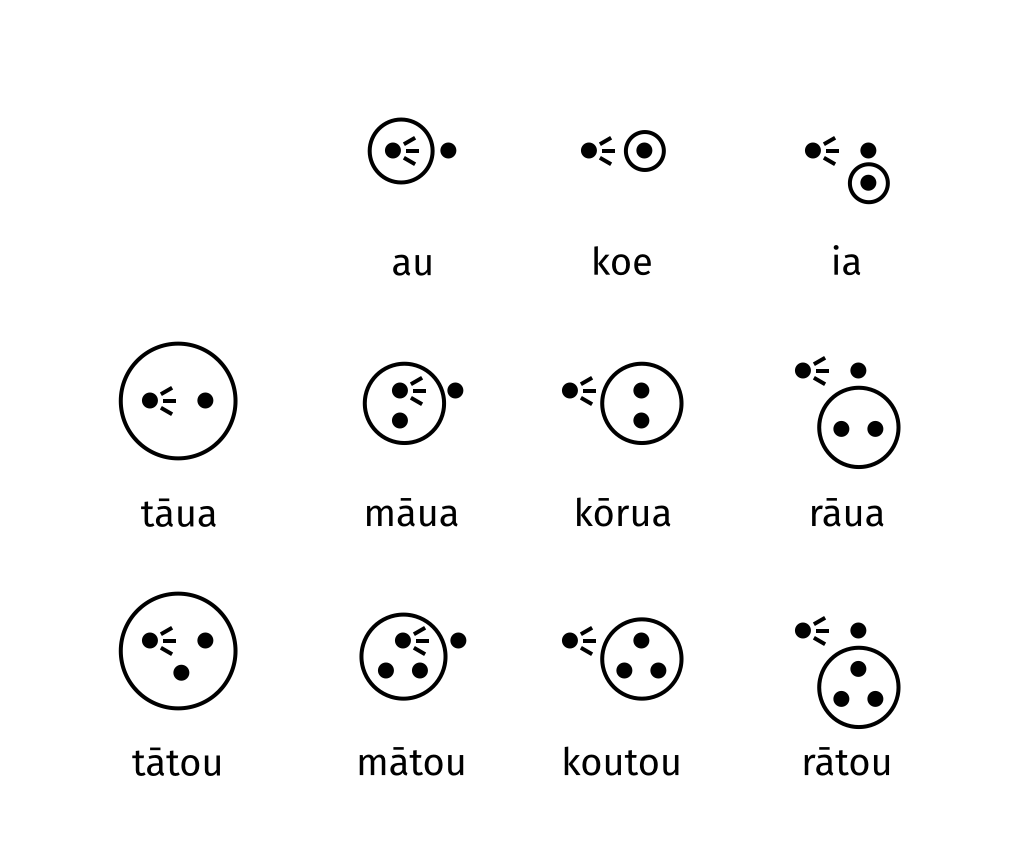
This pikitia might be helpful.
| He tere | au. |
| fast | I |
| I am fast. | |
| He tere | koe. |
| fast | you |
| You are fast. | |
| He tere | ia. |
| fast | they |
| They are fast. | |
By “they”, I mean a singular “he” or “she” et cetera, but there is no gender distinction in Māori personal pronouns.
“ahau” is just an alternate form of “au”. You are free to choose whichever one you want in any given scenario. “ahau” is exempt from the proper article. So “ki a au” and “ki ahau” are both used, but not “ki a ahau”. Refer to the Articles section.
“Dual” means two people are involved.
- “kōrua” = “you two”
- “rāua” = “them two”
“Plural”, in this case, is three or more.
- “koutou” = “all of you“
- “rātou” = “all of them”
The first person pronouns are split into inclusive and exclusive. That expresses whether or not they include the listener. Of course, there is no singular first person inclusive, as an added listener would defy the point of it being singular.
- “tāua” = “you and me”
- “māua” = “me and someone else”
- “tātou” = “all of us”
- “mātou” = “all of us, but not you 😒”